Saturday, 5 December 2015

Bristol DUG Report: Salesforce Christmas Pub Quiz!

On Thursday 3rd December, the Bristol Salesforce Developer User Group met together in the Stag & Hounds Pub. After a year of intense lightning quick app development and trail badge collecting, the last DUG of the year was a special reward, a Force.com themed Christmas pub team quiz.

The quiz consisted of 5 rounds. The first 3 rounds included questions relating to general Force.com development and platform enhancements of 2015, starting easy and getting gradually more testing! The fourth round was a music round, where developers had to identify the artist and title of 5 songs, then for a bonus point, identify the Salesforce related connection between them all.

The final round was titled "Trailhead 2 head". Each team was allocated a device and a developer account logged into trailhead, and given the challenge of earning the Lightning Experience Basics trail badge in the fastest time possible. All teams finished the trial within 5 minutes, a superb effort by all.

BUT WAIT, THERES MORE! After the main quiz was over, all contestants were invited to answer quick fire questions in a special LIGHTNING ROUND! All developers took the hot seat in turn and had 60 seconds to answer as many questions on Force.com development as possible!


Congratulations to the team of Alex Tennant and Fabrice Cathala for the top scores on the night, but there were other winners too!


Even bigger congratulations to Simon and his amazing IoT Christmas Jumper, complete with flashing lights and bluetooth speaker!


Below are the questions from the quiz, feel free to test out your own knowledge, or use them in your own groups!

Happy Holidays to (Salesforce) 1 and all !!!

QUIZ QUESTIONS:
Round 1 (easy)


1: What is the full name (2 words) of the new user interface introduced by salesforce this year?
A: Lightning Experience


2: What is the new name for the previous salesforce interface, which used to be known as aloha?
A: Salesforce Classic


3: 2015 has arguably been the year of trailhead. What is the name of the trailhead adopted mascot, (wears a raccoon outfit)?
A: astro


4: what's the api number of winter '16?
A: 35.0


5: In the previous Salesforce setup menu, does the custom settings option appear under "create or develop"?
A: Develop


Round 2 (medium)


6: True or false, you can add Lightning Components to Visualforce pages?
A: true


7: Text, Number and Date are examples of output types from formula fields, name 3 of the other 4 (bonus point for all four).
A: Date/Time, Percentage, Currency, Checkbox


8: This year, the available developer certifications have been overhauled. Force.com developer and force.com advanced developer have been replaced. Name any of the new developer certifications, or the name of the new certification for individuals who want to demonstrate their skills of implementing custom applications using the declarative customisation capabilities.
A: Salesforce platform app builder, Salesforce platform developer 1, platform developer 2


9: what does SOSL stand for?
A: Salesforce object search language


10: with regards to the order of execution, which of the following occurs first; execution of criteria based sharing, executing escalation rules, or sending emails.
A: executing escalation rules


Round 3 (hard)
11: solve the following anagram to find a Salesforce feature: “HENS GULPING BRISTOL CIDER”
A: Lightning Process Builder


12: When creating test methods for classes that make external web service calls, what interface should you use to imitate responses from the external call.
A: WebServiceMock


13: what annotation can you add to a method in a test class to create test records accessible to all other test methods in that test class
A: @testsetup


14: true or false, you can add bucketed fields to joined reports
A: false, this is not possible.


15: AVG (stands for average) is an aggregate function supported by SOQL. Name 4 of the other 5.
A: 4 from Count(), count(fieldname), count_distinct, min, max, sum


Music round


Listen to the following music tracks - name the artist and the full song title for 1 point


16: Huey Lewis and the News - Power of Love
17: Will.I.AM (ft britney spears) - scream and shout
18: Stevie Wonder - Superstition
19: MC Hammer - 2 legit 2 quit
20: The Beach Boys - Good Vibrations


21: how are all the songs connected? The artists have all appeared in Dreamforce keynotes


Trailhead 2 head - I need to prepare 3 existing dev orgs with trailhead logins, then identify a badge that could be won. Teams will then nominate someone to go head to head with other developers.


Finish the badge within 5 mins - 2 pts
Finish with No mistakes - 2pts
Finish first - 1 pt


Lightning round questions (Asked in random order):


Q: What does DML stand for?
A: data manipulation language


Q: How do you control page layout allocation, roles or profiles?
A: Profiles


Q: What does SOQL stand for?
A: Salesforce object query language


Q: True or false, You can use a * character in SOSL queries to select all fields?
A: False


Q: True or false, trailhead is aimed at developers, and only contains trails for developers?
A: False


Q: Name the annotation that can be used to make private variables and methods readable from test methods?
A: @TestVisible


Q: What is the default single batch size used by the bulk api for manipulating records
A: 200


Q: What is the maximum number of master detail relationships a custom object can have?
A: 2

Q: What is the name of the dashboard report type that displays data in a circular chart with a hollow middle section
A: Donut chart


Q: What is the maximum number of calls to the sendEmail method that you can make during a single code execution?
A: 10


Q: What is the maximum number of DML calls that can be made during a single execution of code?
A: 150


Q: What is the maximum number of SOSL queries that can be made during a single execution of code?
A: 20


Q: Name the method annotation you should use if you want that method to execute asynchronously.
A: @future


Q: What executes first in the order of execution, triggers or workflow?
A: Triggers


Q: If an organization's customers are individuals rather than businesses, they can opt to merge contacts and accounts into a single object. What is the name of that object?
A: Person accounts


Q: The four base types of report are tabular, summary, joined and what?
A: Matrix


Q: In the Salesforce community, What does mvp stand for?
A: Most valued professional


Q: If all users in an organisation should be able to view and modify all records for a particular object, what should the organization wide default sharing settings be for that object?
A: Public Read / Write.


Q: If all users in an organisation should be able to view all records for a particular object, but only some users should be able to edit the records, what should the organization wide default sharing settings be for that object?
A: Public Read


Q: What can be allocated to users to provide them with extra permissions and features that they do not have as part of their profile?
A: Permission sets


Q:What attribute, available for the majority of Visualforce components, controls if the component markup is generated on the page?
A: Rendered


Q: What 4 letter word are core visualforce tags prefixed with?
A: Apex


Q: What 4 letter word are core lightning component tags prefixed with?
A: Aura


Q: True or False, you can create roll up summary fields on both lookup and master detail relationships?
A: False, it is just master detail.


Q: What is the maximum number of lookup filters that can be active on an object at any one time?
A: 5


Q: What name is commonly given to a custom object that links together two other objects through a many-to-many relationship?
A: Junction Object


Q: In a Developer edition of Salesforce, what is the maximum number of custom fields you can define per object?
A: 500


Q: What is the maximum length of a standard text field?
A: 255


Q: What is the maximum number of relationship fields you can have on a custom object?
A: 40


Q: According to Salesforce Governor limits, what is the total number of records you can retrieve using SOQL in a single execution of code.
A: 50,000


Q: What is the maximum number of roll up summaries that an object can have?
A: 25


Q: What attribute of an <apex:page> tag is most commonly used to render the contents of a page in a PDF Format
A: RenderAs


Q: What standard Apex method can be called to transform a lead into account, contact and optionally, an opportunity.
A: ConvertLead()


Q: Name the trigger context variable, only available in insert and update triggers, which contains a list of all of the new records.
A: new


Q: What is the maximum number of characters that can be in an Apex Class
A: 1 million


Q: What website can users access to check the current status of Salesforce servers?
A: trust.salesforce.com


Q: What annotation can be used to mark a method as a test method?
A: @isTest (also accept test method).


Q: There are two types of custom settings, one is list, what is the other?
A: Hierarchy


Q: Which city hosted Dreamforce 2015?
A: San Francisco
Q: Which band headlined the Dreamforce gala this year?
A: Foo Fighters

Monday, 14 September 2015

Lightning Experience Trailblazing!!!

In a special global broadcast, Salesforce recently launched the 'The new Salesforce'. This new Salesforce came in the form of the 'Lightning Experience', a new, responsive, crisp UI, that takes your existing Salesforce data and presents it in a much more modern graphical manner. It's responsive, and aims at providing a unified experience and appearance across all your devices, from watch to phone to tablet to desktop. Check out the introduction and demo video from the Salesforce website.

This announcement was great, it left users looking forward to getting started with the new interface. However, as a developer during this initial presentation I had a lot of questions; What does this mean for all the Visualforce I've written? How do I make my pages look like they belong in Lightning? Do I need to build two versions of everything (Lightning Exp. and Classic) in order for stuff to work for everyone? Are there any kind of code techniques and tweaks I use at the moment that won't work anymore?

Fortunately though, answers weren't far behind, as Salesforce Developers released several new Trailhead learning tracks that address these questions, respond to common concerns and let you get hands on with building some Lightning Components for the new UI. For those have never used Trailhead before, it's an amazing learning tool that provides Salesforce users from all walks of life (CRM User, Admin, Developer) with exercises, both written and practical, for learning more about how to make the most out of Salesforce. There are four new trails (with shiny badges) to get your teeth stuck into:


The two admin trails guide you through the process and best practice of moving your existing Salesforce Classic organisation over to Lightning Experience, and explore how to use the basic features of the new UI once you have made the switch. The Sales Rep trail takes you through the experience from an end user perspective, showing how to use the new features to make better sales. The developer trail includes elements of the admin trails, but also explores how to manage your existing custom coded functionality and build new apps effectively in the new UI.

Although all four are definitely worth doing no matter what your role is, as a developer the one trail your should definitely tackle, unsurprisingly, is the Lightning developer track. Taking a closer look, the track consists of 5 different modules, each of which provide a different view of the Lightning Experience and answer different questions you may have.

Name Content Questions it answers


Lightning Experience Basics
An Overview of the new UI, and what it means to both new and existing Salesforce organisations. Includes tips on how to conduct a gap analysis when considering making the switch to the Lightning Experience, before turning it on.
  • What is Lightning Experience?
  • How do I know if my organisation is ready to make the switch?
  • How do I turn it on?


Lightning Experience Development
Looks at how your existing use of Visualforce will be affected when using the Lightning Experience. Explains what elements will continue to work, those that do not (for now) and what elements will need reviewing.
  • Will my existing Visualforce pages still work in Lightning Experience?
  • Are there any existing paradigms and features no longer supported if I make the switch?
  • How does this affect my products as an ISV?


Visualforce & Lightning Experience
This unit goes into further detail about the relationship between Visualforce content and the Lightning Experience container it will be presented in. It also contains recommendations for styling and methods of identifying if a user is accessing the Page through each of the different UIs.
  • How will Visualforce content be presented in Lightning from a technical perspective?
  • How can I prepare a Visualforce Page for use in both Salesforce Classic and Lightning Experience simultaneously?
  • Will my Page actions and Visualforce navigational methods still work?


Lightning Components
An introduction to the development of reusable Lightning Components. This is not a new unit, but with the introduction of the Experience, has been given extra importance and greater context.
  • How do I build and style a basic Lightning Component?
  • How do I pass attributes between different Components?
  • How do I get Lightning Components to run Apex Code?


Lightning Design System
Introduced alongside the Lightning Experience, the Lightning Design System is a tool that aids in the design of Pages to make them look and feel right at home inside the new UI. This unit explores how to use the tool and how to take your app design to the next level.
  • What is the Lightning Design System and why should I use it?
  • How do get my existing apps and pages to look and behave like the rest of the Lightning Experience?
  • How can I include some cool Lightning design elements such as icons and avatars easily into my Pages?

As you can see, the trail covers a lot of ground; it includes 30 individual units, and takes around 10 hours in total to complete, so prepare to lose a few evenings or a weekend, but trust me, it's totally worth it!

From a personal point of view, what I really like about the Lightning Experience developer trail is the practical and honest way it presents the new Lightning Experience, and really gets down to the point in terms of what developers need to know. It's not a sales pitch, shouting "Lightning Experience is here, there is no effort in transition from Salesforc Classic and it makes all your existing stuff magically more amazing!". It is a frank explanation of what will definitely work, what won't, changes you will have to potentially make to existing Visualforce Pages and how to effectively develop a transition strategy between Classic and Lightning.

I also think the inclusion of the unit based around the new Design System is a great idea. In the past, I have always found it challenging to get started with designing content for mobile and Salesforce1, simply because the appearance of anything I developed didn't seem to fit 100% correctly into the look and feel of the app as a whole. The Design system gives you that boost to start developing crisp looking custom content for both mobile and content with the new UI without the hassle and instability of large quantities of highly customised CSS.

From the trail content, it makes it really obvious that Salesforce have spent a lot of time working out the best way to introduce the Lightning Experience to existing developers. It addresses a lot of the concerns developers have, and covers both the management and adaptation of what you already have, whilst also illustrating the best way to build new apps as part of the new exciting UI.

One of the only slight frustrations of the trail is that is it largely tested through questions and answers rather than practical assignments. Those are always the trails that I enjoy the most. But this is only a short term gripe, as I have no doubt more practical exercises will emerge after the feature is GA.

In summary it's a great way to introduce yourself to the new look Salesforce before it storms into orgs as part of Winter '16. So, if you haven't already, get to Trailhead and get Trailblazing! Don't forget to show off those badges!

Thursday, 12 March 2015

Bristol DUG Report - Lightning Developer Week!

On 11th March, the latest installment of the Bristol Salesforce Developer User Group was held at Desynit HQ in Bristol. The meetup formed part of Lightning Developer Week, 9th - 15th March, a series of worldwide events offering developers to opportunity to get hands on with Salesforce1 Lightning.

Lightning is a component framework and set of tools specifically designed to rapidally speed up the app development process for developers, admins and analysts. After a brief introduction, Force.com MVP and DUG co-organsier Simon Goodyear provided a great overview presentation of the different key aspects of Lightning, and the business problems they solve.


Following on from Simons presentation, I jumped in to provide a live demo of each of the core features and how they can be used in conjunction to make powerful app functionality quickly. This was followed up by a slightly deeper exploration of Lightning component code structure (we devs do love a bit of code after all).


After the tour, developers were then given the opportunity to get hands on with some tutorials. If you are interested in getting hands on yourself, here are the links for the different exercises:

 
A really great meetup, plenty of good questions, successful tutorial completions, swag, and ideas about the future of SF development. I'm looking forward to the next meetup already! Make sure to join our meetup group for announcements of future meetings.

PS. I just hit the 100,000 pageviews mark! Thanks to all who have viewed my blog, here's to the next 100,000!

Thursday, 18 September 2014

Bristol DUG Report - Enterprise Design Patterns and Salesforce Dev Quiz!

On the 17th September, the latest Bristol DUG meetup was held in the Elephant Pub in Bristol. In this edition, Andrew Fawcett, CTO of Financial Force, gave a great talk on Enterprise Patterns and the best techniques to use to keep your code organised. The talk contained exerpts from his forthcoming presentations on the subject at Dreamforce 2014, where he demonstrates the improvements to maintainability and adaptability of code which is divided by concern.

Check out the Preview of Advanced Apex Enterprise Patterns Session post on Andrew's blog to get a flavour of the content.


Following the talk, and a recharge of glasses, the first annual Bristol DUG Pub quiz was held. Entrants were treated to 20 quick fire Salesforce development questions (found below, just in case you want to run a similar event at your own DUG). The eventual winner was Alex Tennant, with an impressive score of 16.5!


  1. Q: What does DML stand for?
A: Data Manipulation Language

  1. Q: Name the four types of action you can do as the result of workflow
A: Task, Field Update, Outbound Message, Email Alert.

  1. Q: What number API version is Winter ‘15?
A: 32

  1. Q: Name four programming languages that heroku supports (A cloud trivia favorite of mine)
A: Ruby, Java, Node.js, Scala, Clojure, Python and PHP, Perl (Undocumented).

  1. Q: Name two of the Visualforce tags that belong to the chatter group (IE Chatter: instead of Apex: , not ChatterAnswers:)?
A: feed, feedWithFollowers, follow, followers, newsfeed, userPhotoUpload

  1. Q: Governor limit maths: what is the Total number of methods with the future annotation allowed per Apex invocation x Total number of DML statements issued - Total number of sendEmail methods allowed
A: 10 x 150 - 10 = 1490

  1. Q: True or False, You can deploy a maximum of 5,000 files as part of an individual change set?
A: True

  1. Q: Name the Salesforce API that you can use to build custom development tools for Force.com applications.
A: Tooling API

  1. Q: In the setup menu, does “Static Resources” appear under the “Develop” or the “Create” sub menu?
A: Develop

  1. Q: Name 5 types of charts that can be used in reports and dashboards?
A: Bar Charts, Column Charts, Line Charts, Pie Charts, Donut Charts, Funnel Charts, Scatter Charts.

  1. Q: Who is headlining the Dreamforce gala this year (2014)?
A: Bruno Mars

  1. Q: Which of these is not a standard salesforce object accessible via SOQL - AccountTag , Question or CaseEscalationRule?
A: CaseEscalationRule

  1. Q: In the order of execution, what occurs first, escalation rules or assignment rules?
A: assignment rules

  1. Q: What is the former name of Salesforce Tower in London, which resides on Bishops Gate (bonus point for correctly guessing the number portion of the address)?
A: Heron Tower (Bonus point for number 110 Bishops Gate)

  1. Q: True or False, The salesforce Advanced Developer certification is a prerequisite for taking the technical architect certification?
A: False, you can just do developer

  1. Q: According to trust.salesforce.com, How many EMEA instances (ie EU servers) do salesforce currently host?
A: 4 (EU0, EU1, EU2 and EU3)

  1. Q: When using batch Apex, you must write an Apex class that implements what Salesforce-provided interface?
A: Database.Batchable

  1. Q: Name the two different types (or varieties) of custom setting objects that be created
A: List + Hierarchy

  1. Q: Name the three types of Salesforce collections in Apex
A: List, Set, Map

  1. Q: Name 3 of the annotations supported in apex classes (hint, they all begin with the @ symbol)
A: @Deprecated, @Future, @IsTest, @ReadOnly, @RemoteAction, @TestVisible, @RestResource, @HttpDelete, @HttpGet, @HttpPatch, @HttpPost, @HttpPut


Thanks to all who came along, see you all next time, where we will no doubt have some Dreamforce content! Possibly a report back from the $1Million Hackathon


Sunday, 31 August 2014

Woo Hoo! I'm going to Dreamforce 2014, here's 5 reasons why you should too!

In case you've been living under a rock, you are probably already aware that Dreamforce is the hottest Salesforce event of the year. Every year Salesforce experts and enthusiasts take over San Francisco for a full 4 day conference. Every year the event get's bigger and better, with more breakthroughs, key announcments and cool platform features emerging.

I consider myself very lucky (and thank my employers Desynit) for letting me go to Dreamforce 4 years in a row now. I have previously written a blog post on my trip to Dreamforce 2013, so check it out if you want flavour of what the conference experience is like. But enough about the past, here are 5 top reasons why you should grab a flight to San Francisco and attend this great event this year:

1) The Keynotes

Every year, Salesforce CEO Marc Benioff delivers a massive keynote to tens of thousands of attendees under the Moscone outlining the direction Salesforce is taking as a company, and the enhancements they are making to their product range. The session is always full of interesting case studies regarding companies who are currently using Salesforce to push the boundaries of what is possible.The keynote also highlights the Philantropic efforts the company makes as a whole, and being in such a massive room, you geniunely feel like part of something great.


But it's not all about the Benioff mega show, for the Developers, the Developer keynote provides the community with a view into what the future holds for the Force.com platform, Heroku and APIs. This session always includes some very cool demos of some of the latest features/tools. If you want to attend this session, better be quick on your feet, space is more limited than the main keynote, and it always fills up. I've even known people to be leaning against the theatre entrance door to try and hear the presentaion!

2) The Expert Lead Sessions

Got a problem you just can't get around in your Salesforce implementation? Want to know more about a new feature? Want to learn how to master an existing feature? Then the break out sessions are here to save the day. Dreamforce offers an every increasing array of excellent content from product managers and community experts. Here is the full list of  Dreamforce 2014 sessions .


<Shameless Session Plugs>While we are on the subject, there are two sessions you should consider attending this year. In Clicks vs. Code: Deciding how to build, Simon Lawrence and I will debating the benefits and drawbacks of declarative and programmatical approaches to create functionality within Salesforce. Also, if you are a developer and are considering taking some certification exams, or want some tips on how to successfully pass, you can hear my full personal journey through the certification process in my session called Salseforce Certification - A Developer Journey </Shameless Session Plugs>

3) Hands on Training

It's scientifically proven that people learn more effectively when they experience something first hand, rather than just being told about it. Dreamforce offer several expert led hands on sessions and mini workshops, where attendees can be guided through anything from building their first app, to best testing and batch processing code techniques. Any questions? One of the session assistants will be on hand to answer any queries or problems you have. I have attended these sessions in previous years, and I still refer to the some of the lessons I learned on a daily basis, I can't recommend them highly enough.

4) The Devzone

I maybe be *slightly* biased being a Force.com developer, but honestly the best thing for me about Dreamforce is always the Devzone. This is a slice of dev paradise, with constant developer sessions, hands-on workshops, mini hack challenges, and product demos all around. Everyone in the Devzone is really helpful and enthusiastic, I challenge anyone to enter the Devzone with a Salesforce development question and not have it answered by the time they leave. Just one thing though, remember to leave space in your suitcase for the crazy amount of free training books and swag you will want to bring back with you!


5) The "Dreamforce Glow" effect

Every year after attending Dreamforce, every attendee I have ever known has always returned to their office positively buzzing. The new skills you will have gained, contacts you have made and the sheer scale of the keynotes always gives you a sense of great positivity for the future and raring to start clicking and coding in the cloud all over again.

Any time lost or cost accrued in attending the event is quickly made up for by the new efficiencies you find in the way you work, and the found again mega-enthusiasm you will have for what you do.


Soooo, shall I see you there?

Thursday, 21 August 2014

Bristol DUG Report - Accident Alert: A Summer of Hacks Story

Last night, at the Llandoger Trow in Bristol, the Bristol Salesforce Develoer User Group met up for another chance to chat code and talk about development on the Force.com platform.


The central theme of this latest event was hackathons, specifically the Summer of Hacks London event run by Salesforce last month. A presentation was given by the local Bristol team from Desynit behind the winning entry, an app called "Accident Alert". The app built at the hackathon used the Salesforce1 platform to provide users with the ability to record potential health and safety hazards around the workplace.

The open panel discussion included the three core members of the team (Matthew Morris, Shaun Holmes and myself), and covered how the team went about building the application, how we stayed sane through all night development sessions (coffee and chicken burgers),  and the lessons we learned about good application development.


This presentation wasn't just about the winning entry though, it was primarily about the experience of participating in hackathons, why they rock, the amazing people who attend and how everyone should sign up to them in the future. It's not all about technical expertise and being able to write code, it's all about identifying a potential new application or tool that is of genuine use to Salesforce users, and creating a prototype to fit that bill.

Here is the slide deck from the event:


Continuing on the theme of hacks and development, we were also honored to have a special project presentation by our youngest ever presenter Dara Morris, who presented a highly addictive jet fighter game he recently developed at a hack event. It seems the future of development is bright in the Bristol area!


Want to get involved and attend the Bristol DUG? Then check out the Bristol DUG Meetup page.

Not in the South West of the UK? Then check out the full list of Salesforce Developer User Groups.

Still no luck? Then start your own, add a comment to this post if you want to find out how!

Saturday, 19 July 2014

Summer '14 Release: 7 Force.com Development need to knows!

Summer is officially here. The sun has his hat on, the Pimms is flowing and the BBQs are firing up! Also just like each Summer, Salesforce is making one of its three annual releases. In Summer '14, we see the introduction of extensions to user permissions, a massive increase in API calls, and the ability to handle much larger files as attachments on Objects and e-mails.

The training material for Force.com (for those looking to pass their maintainence exam or find out more about the release) is pretty quick, lasting just a shade over two and half minutes. Viewing this alone, you may be tricked into thinking the only change of note is to user access permissions.

What I want to do in this blog post is dig deeper, way down into the release notes, and demonstrate the not so well known features that are going to be introduced as part of this latest release, that make things possible on the platform for the first time, and can alleviate previous restrictions. I have also included a few new features that you need to be aware of that may impact your org in the future.

So without further ado, here are my 7 need to know features in Summer '14 release:

1) Light vs. Enterprise Objects

As part of Summer '14, when you create any new objects, you will be asked as part of the initial configuration, a series of questions about the your new object:

Allow Sharing (checkbox)
Allow Bulk API Access (checkbox)
Allow Streaming API Access (checkbox)

These settings are all or nothing. If all of the objects are selected, your object will be classified as an "Enterprise" object, if you uncheck all, it will be classified as a "Light" Object. All objects created prior to Summer '14 will be classed as "Enterprise" objects.

So ok that's nice, but why is that relevant you ask? Why would you ever choose a "Light" Object? (apart from if have very selfish users :-D ) . Well this actually all comes down to Licence arrangements for your org. Since Spring '13, The Force.com light licences have been available. There isn't much information about these licences out there, but thankfully Shell Black has a great post explaining licenses.

Basically, if in your org certain users cannot see types of custom object, checking if it is a "Light" object is probably a very good place to start.

2) Increased Maximum Length for Long Text and Rich Text Fields

Long text fields can now be edited to be four times as big in size, 128KB rather than 32KB (or 131,072 rather than 32768 characters). A small change but will free up some implementation concerns, so now your users can ramble to your hearts content!

3) Increased Maximum Number of Relationship and External ID Fields Available Per Object

The number of relationships (lookups/master-details etc.) per object has been increased from 25 to 40, particularly useful if you have complex data models (though in all honesty if you do need all 40 relationship fields, you may want to review your data model!).

Also, the number of fields that can be labelled as External Ids, useful for uploading records from other connected systems with their own unique referencing models, has been increased from 3 to 7, so its now even easier to upsert your existing system data.

4) Full File Search Now Available in the Developer Console

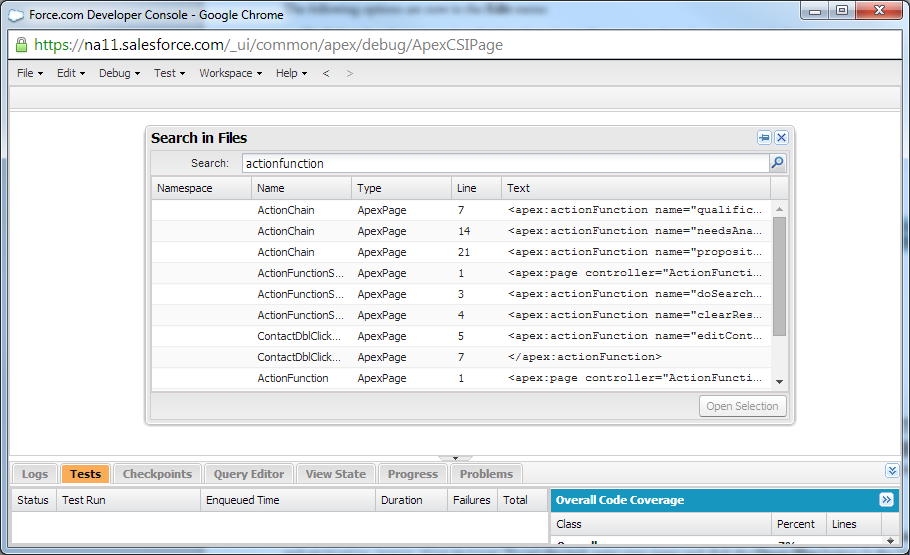
For me, one of the benefits of using an external IDE over the developer console has been the ability to quickly identify search your entire codebase for a particular tag or method, using a complete file term search. An example is when you have a question like"I'm sure I've used the apex:ActionFunction in this project before, but where?". With Summer '14, a complete file search function has been added. Simply go to Edit > Search in Files in the menu, or use the keyboard shortcut (CTRL + shift + H) to open the dialog, and then enter your search term.


There are currently some usability limitations, for example you cannot use a search term that contains a ":" character (like when searching for an apex tag), and there are only so many results that can be returned in the panel. Despite this, I think this still a really good addition to the developer console.

5) Remote Object Enhancements (Developer Preview)

In Spring '14, a new method of interacting with objects via Javascript was introduced in the form of Remote Objects. Using Remote Objects allows you to modify the data in your org purely at the view level using Visualforce alone, you do not have to define any logic in Apex classes. You can read more about Remote objects in this Remote Objects blog post by Josh Birk

The Summer '14 release extends this new feature further, with the addition of an upsert command to update or insert objects based on if they already exist (just like with SOQL). You can now also order your results on the page using an orderby command, use geo-location fields, and use more complex query conditions (not equal, less than or equals, greater than or equals). These enhancements will make it even easier to replace large chunks of Apex code with lightweight Javascript. Give it a go if you haven't done so already!

6) Unlimited Describe Calls

Describe calls are used in Apex to dynamically access the data model configuration of your org. You can use describe calls, for example, to view the possible values of Picklist fields, or even get all of the fields that belong to an object. I have used these methods successfully in previous posts, especially those regarding cloning objects.

Previously Describe API calls have been limited to 100 per code execution process. In summer '14 this limit has been completely removed, so you can make as many calls as required. A couple of words of warning though, remember that this limit was there originally for a reason, if you are running code that is using the describe method over 100 times, you may want to consider if there is not a more efficient way to get the information you need. Don't get slack in your coding just because the limit is gone :D.

7) Create Price Book Entries in Tests

This is a win for anyone (including myself) who has ever had to create a test relating to price book and price book entries. Before this release, the only way to access a price book to create entries was through the use of the *evil* seeAllData=true flag in your tests. Now, thanks to the new Test.getStandardPricebookId() method, you can access a price book and associate new Price Book Entries without having to access all data.

Here is an example of the method in use, taken from the Summer '14 Release Notes:

@isTest
public class PriceBookTest {
    // Utility method that can be called by Apex tests to 
    // create price book entries.
    static testmethod void addPricebookEntries() {
        // First, set up test price book entries.
        // Insert a test product.
        Product2 prod = new Product2(Name = 'Laptop X200', Family = 'Hardware');
        insert prod;
        
        // Get standard price book ID.
        // This is available irrespective of the state of SeeAllData.
        Id pricebookId = Test.getStandardPricebookId();

        // 1. Insert a price book entry for the standard price book.
        // Standard price book entries require the standard price 
        // book ID we got earlier.
        PricebookEntry standardPrice = new PricebookEntry(
        Pricebook2Id = pricebookId, Product2Id = prod.Id, 
        UnitPrice = 10000, IsActive = true);
        insert standardPrice;

        // Create a custom price book
        Pricebook2 customPB = new Pricebook2(Name='Custom Pricebook', 
                                             isActive=true);
        insert customPB;

        // 2. Insert a price book entry with a custom price.
        PricebookEntry customPrice = new PricebookEntry(
        Pricebook2Id = customPB.Id, Product2Id = prod.Id, 
        UnitPrice = 12000, IsActive = true);
        insert customPrice;

        // Next, perform some tests with your test price book entries.
    }
}

Thursday, 16 January 2014

Force.com Development: 10 things that blew my mind in 2013, and what they mean for 2014


2013 was a great year for Force.com developers. Below are my top 10 reasons why 2013 rocked, and what they mean for the year ahead.

1) The Salesforce 1 Platform

What happened in 2013: Of course, no-one could talk about Salesforce in the past year without mentioning the all-in-one mobile ready Salesforce 1 Platform and App. When this was released at Dreamforce, I was amazed at how well executed the launch of the product was, overnight chatter mobile was magically transformed into the Salesforce 1 Mobile app.


What it means for 2014: Everything. A lot of development teams and businesses are changing their model to "mobile first", so the quicker developers become familiar with the 1 platform, the better. In the coming year, Salesforce 1 will be enhanced with new features (safe harbour :p ) and become the first point of org contact for many users. I am really looking forward to getting stuck into building some cool mobile apps that combine the power of the Force.com platform with native mobile features.


Find out more : Salesforce 1 Platform Overview

2) Connected Devices

2013: The year "The internet of things" became "connected customers". We were reminded that behind every device, sensor, and flashing LED is a person with a story. The Connected Devices Lab at Dreamforce was truly inspiring, giving developers a chance to build things that interact with more than a screen and keyboard. I would say that connected devices grew up this year, but I enjoyed playing the fruit piano in the CDL too much to back that up.

2014: I really feel that this year we will begin to see more emergence of practical connected systems. Up until now these systems have been largely conceptual / DIY. Expect more widespread adoption and innovation this year, with real world data directly driving systems and vice versa.

3) Elevation!!

2013: Throughout last year, Salesforce ran several ELEVATE free one day hands-on training events, designed to get people interested in the platform started, and also educating advanced developers on mobile app best practices. In November, Bristol held an ELEVATE event for the UK. I co-ran the beginner track training, and it was a fantastic experience. I was really impressed at how much the local development community embraced Salesforce as a platform, and quickly understood the key concepts and tools. It was great as an experiened Force.com dev to take a step back and appriciate the building blocks of the platform all over again.

2014: There already a number of Elevate events planned for this year, and with a new syllabus that includes the Salesforce 1 Platform, there should be something for everybody at these events. Watch this space, we could be coming to a city near you soon.
Find out more: Any upcoming elevate event details will appear on the Developerforce Calendar.

4) Supercharged hackathons

2013: Last year, Salesforce hackathons hit the big time. The $1,000,000 hackathon offered developers with the opportunity to change their lives by building an application using Force.com. Mobile hack week in April, promoting the mobile capabilities of the platform, linked together the different user groups worldwide. Alongside the already popular mini-hacks, and product specific hacks, there was plenty of hacking to be had.

2014 : Expect a lot more competitions at Salesforce events, with massive participation, and suitably gargantuan prizes. At a guess I would also expect a couple of themed weeks for developer user groups. I am certainly going to be participating (and help run) some hacks this year.

Find out more: The Dreamforce Hackathon

5) Salesforce devs embrace the stack exchange

2013: The Salesforce Stack Exchange is a question and answer community site for all things Force.com. The exchange has picked up a lot of momentum in the past 12 months, now boasting nearly 3500 active members. If you haven't got an account, what are you waiting for? Sign up, sign in, and start asking and answering. The community are really quick to respond to questions, with quality answers.

2014: Even more adoption. More questions, more answers, and more badges being handed out to development community. I do also predict a slight move away from the Salesforce developer forums for developer queries, the stack exchange has a much more natural question and answer format.

6) There's an API for that

2013: There are now 10x more APIs than there were previously available for the platform.

2014: This year there will  be many more apps that take advantage of these extra APIs, and alongside more advanced mobile integration, prepare for more development release/testing apps. The extra exposure the core elements of the platform now have will allow developers to apply greater control over their orgs and development environments.

Find out more: All the API defintions are available through the developer documentation section of developer.force.com

7) Books and knowledge galore

2013: I was lucky enough to be asked to review two great books on the subject of Force.com development. The Salesforce CRM Admin Cookbook by Paul Goodey, which although aimed at administrators, has loads of great tips for developers too, and provided solutions to some of the common problems.
Keir Bowden's Visualforce Development Cookbook is a book I would recommend to any Force.com developer, regardless of experience. If you have just developed your first app, or have been using the platform for 10 years, you will find some incredibly useful tips and advice.

2014: I am hopefully going to be reviewing some more books in the next 12 months. If you are in the process of writing or publishing a Force.com Development / Administration and would like a review, by all means add a comment below.

Find out more: Check out my review of the Salesforce CRM Admin Cookbook, and also have a look at the Visualforce Development Cookbook.

8) Getting certified is a journey

2013: From a personal perspective, A lot of my 2013 was centered around certification. I got my Force.com Administrator certification to go alongside my existing Force.com Developer and Force.com Advanced Developer certifications. But it wasn't just my own certifications that were important, I made it my mission to guide others through the process. I was lucky enough to be part of a panel session at Dreamforce entitiled "I passed the advanced developer certifiicaiton". I also helped 5 members of the Desynit team become certified by passing on my knowledge of the platform.

2014: Certification is always going to be important, it helps you to prove you know your Salesforce. This year, I will be helping to train more developers and administrators, and also publishing via blog/presentations my experiences of the certifications, and my recommendations to anyone undertaking an exam. Plus there is always that little matter of the Technical Architect.

Find out more: Developer Certification

9) Command Line Interface tool

2013: The command line interface (CLI) tool was a major part of the developer keynote at this year’s Dreamforce. As the name suggests, it provides text command line access link to your salesforce org. You can manage objects and configuration, execute SOQL queries and even execute apex code right from a simple prompt. If you want to be able to configure an org quickly, this is the tool to use.

2014: I am really looking forward to getting hands on with the CLI tool this year. I can certainly see it being part of my org intialisation process for new projects, but that is just the start. Speed is the name of the game with the CLI, and I can really see it speeding up a lot of some of the slightly more long-winded configuration processes.

10) The developer console is gaining momentum

2013: This year the developer console became more than a nice side feature that could be used to develop Force.com code, it started to become the number one tool for developing through the web. The console moved much more towards a complete online fully fledged IDE, rather than just a tool for executing anonymous code and debugging.

2014: The developer console will continue to gain more and more traction. More features will be added throughout the year, and it will be faster. Don't be surprised if some of the configuration and development tools start to be removed from the GUI and placed exclusively in the developer console. Of course there is still a major lean by developers to use desktop based editors such as Sublime and Eclipse, but as the console gains more features and speed, heads will definitely start to be turned.

With all these innovations / new tools, 2014 is shaping up to be a great year for Force.com developers. I can't wait to get stuck in.

What are you looking forward to this year? Add a comment below!

Friday, 10 January 2014

Bristol DUG (FxFW) - New Year? New Salesforce Certificate!

On Wednesday 8th January, Bristol held it's first developer user group event of the year. The theme of the event was certification. As we start the new year, many developers are looking for ways to improve their skills over the coming year, and what better way than taking the challenge of gaining some official Salesforce certifciation.

There were two presentations during the night. Fellow Desynit developers Simon Lawrence and
Julio Fernandez (both certified Force.com developers) provided a guide to the Force.com Developer Certifcation. The talk included an explanation of the certifcation format and process, alongside their own personal experiences. Copies of the slides for this presentation and more information about the Force.com Developer Certifcation are available on Simon's Blog, and also Julio's Blog .


Following this, I took to the mic and presented my section of the "I passed the advanced developer certifcation" panel session I co-presented at Dreamforce 2013 . Again this presentation was a combination of background information about the certification process, with some practical advice and insights from my own experiences. A video of the full presentation from Dreamforce can be found on my Dreamforce Diary post.


After the presentations, group discussions began, at first focusing on the certifcation processes and aims for this year, but topics eventually spread and evolved into change sets, single sign-on, the metadata API and preferred development environments amongst others. 


I really enjoyed the event, it was a great chance to catch up with the local Force.com development community. There is a real feeling of enthusiasm for the coming year ahead.

I'm really looking forward to the next Bristol DUG, scheduled for Wednesday 5th March. Richard Donkin, CTO of Cloudfind, is going to providing a session on Salesforce Canvas. So if you fancy learning about integrated external apps or talking Force.com development over a free beer, please sign up to our Meetup group.